
The Lion Knockers on the doors to leading into the Municipal Building / City Hall

 13th of September 1948, the Royal Warrant was issued, granting a Coat of Arms to the Colony of Singapore

Singapore was reported to be presented with the “Lion passant (paw raised) guardant on a tower” as its coats of arms or charge by the colonial secretary when the Straits Settlements were governed directly from the Colonial Office, London 1st April 1867.
This emblem was adopted on 4 March 1957 by the 1st Singapore Infantry Regiment upon its inception, as its Cap Badge. This emblem is still used on the gold buttons of the present day Singapore Armed Forces ceremonial dress.
It can also be found at the gate entrance to the Old Kallang Airport – which was opened in 12 June 1937, when the Director of Public Works, Major RL Nunn addressed the opening speech.
On 25th March 1911, the charge i.e. gold lion passant guardant on a white tower was present in the Arms of the Colony of the Straits Settlements in the first quarter of the quartered shield representing each settlement; with Penang (An Areca palm – Pinang) in the 2nd quarter, a sprig of leaves and fruits of the Keruing Tree representing Malacca on the 3rd quarter and a schooner headed towards Mount Kinabalu in the last quarter, depicting Labuan.
The Lion Statant – a lion with both paws grounded with a coconut palm tree, was also used to represent the Singapore Municipal Commissions. How this came about was unclear?
The Municipal Authority of Singapore existed from the 1820’s to 1930’s. By 1929, there were 7 standing municipal committees, each having 5 or more commissions, with work as follows;
- Secretariat, assessment , vehicles and dog registrations
- Health, markets, slaughterhouses, town cleansing, sewerage & street watering
- Municipal Engineers Department, roads, canals, piers, bridges, drainage, stores
- Buildings, Architects department and the fire brigade
- Water, gas, Electrical department
- Parks & Open spaces
- Finance & General purpose
The lion with the palm tree emblem has been adopted by the Singapore Volunteer Corps from 1928 and the Singapore Fire Brigade
The Arms of the Singapore Municipal Commissions was granted by letters patent on 9th April 1948. The official heraldic blazon for Singapore was:
“The arms of the municipal commissions featured a gold lion passant guardant on a white tower, as per the first quarter on the 1911 arms of the Straits Settlements. The charged pair of blue wings between two blue anchors represented the trade hub role of Singapore. These were featured in the shield.
The arms of Singapore used the crest of the Singapore Municipal Commissions, a lion statant with a coconut palm tree. The new arms crest however, has the lion as a lion passant (paw raised) and not statant. The wreath was emblazoned in blue and silver. The motto scrolled was “Majullah Singapura” in Malay – translated then to English was “Let Singapore Flourish”? – The English version motto could be found on the helmet plate of the Singapore Fire Brigade.
On 13th of September 1948, the Royal Warrant was issued, granting a Coat of Arms to the Colony of Singapore. Again, the shield featured a gold lion passant guardant on a tower, but the crest was a demi-lion rampant guardant holding the banner which was attached to a staff, with a red inverted pall, charged with a single crown on a white field. The wreath was emblazoned in gold and red.
In December 1959, when Singapore attained self government as a State of Singapore, the present flag and Coat of Arms, with the lion holding on to the shield of the crescent moon and five stars, has since been adopted


 Signed off by Rodolfo Nolli at the corner of the lion roundel
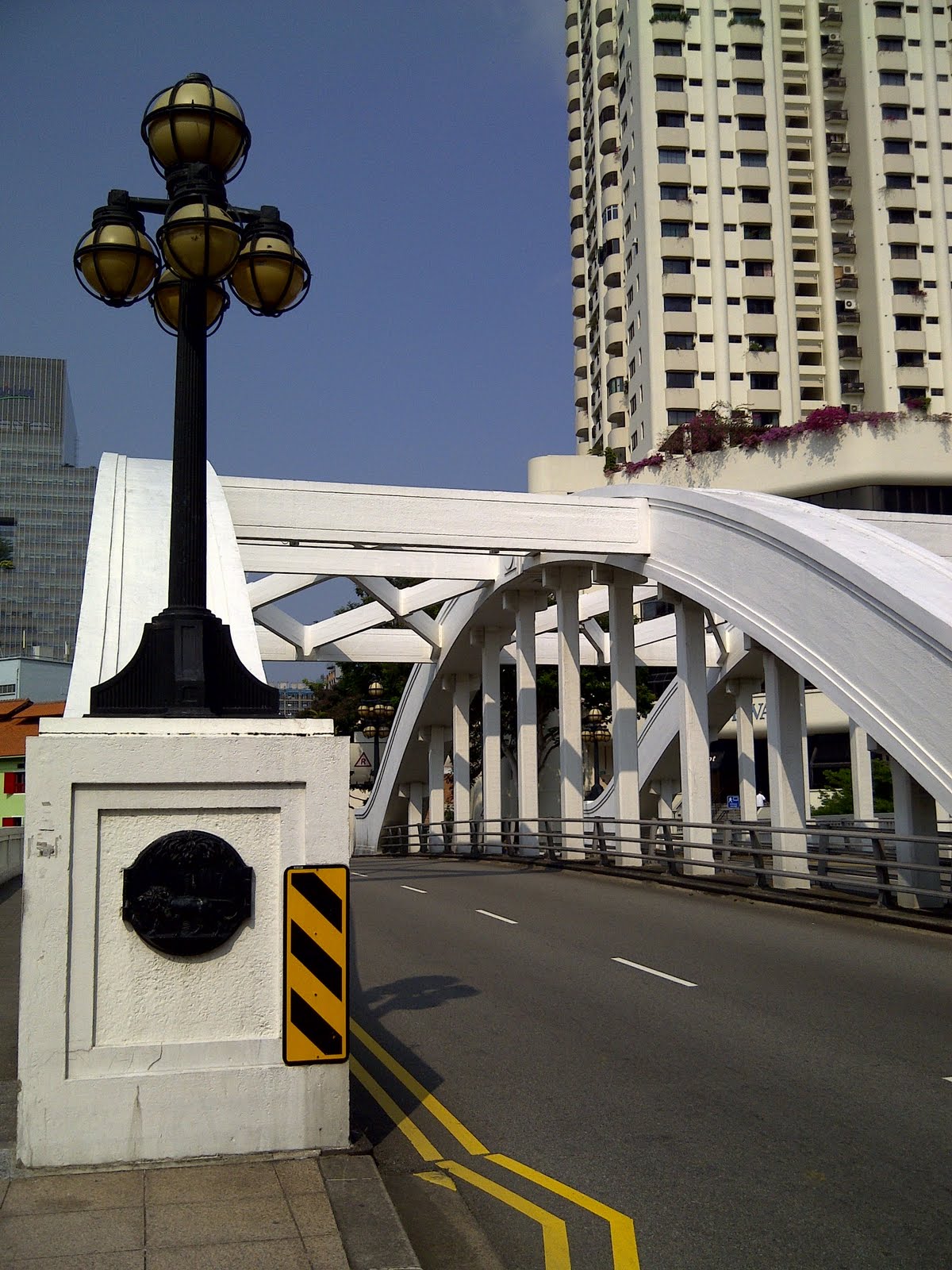 Lion roundels on the Elgin Bridge
 Close up of the lion relief - possibly the cover for the gas man to turn on the gas for the bridge lights during the bygone days!


